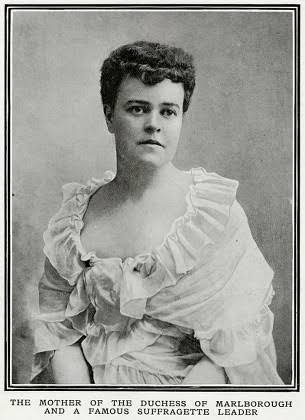
 Alva Erskine Smith Vanderbilt Belmont (January 17, 1853 – January 26, 1933) was an influential American socialite, prominent Gilded Age figure, and leading activist for
women's suffrage and labor rights.
Alva Erskine Smith Vanderbilt Belmont (January 17, 1853 – January 26, 1933) was an influential American socialite, prominent Gilded Age figure, and leading activist for
women's suffrage and labor rights.Husband William Kissam Vanderbilt
Queer Places:
Marble House, 596 Bellevue Ave, Newport, RI 02840
Woodlawn Cemetery, Bronx, Bronx County, New York, USA
Alva Erskine Smith Vanderbilt Belmont (January 17, 1853 – January 26, 1933) was an influential American socialite, prominent Gilded Age figure, and leading activist for
women's suffrage and labor rights.
Born in Mobile, Alabama, to a wealthy slaveholding family, she lived in France following the Civil War before returning to New York.
In 1875, she married William Kissam Vanderbilt, grandson of Cornelius Vanderbilt. Together they built grand mansions—including Marble House in Newport, Rhode Island—and hosted high-profile social extravaganzas. They had three children.
In 1895, she shocked high society by divorcing Vanderbilt on the grounds of his adultery, receiving a substantial settlement and retaining Marble House.
In 1896, she married Oliver Hazard Perry Belmont, a wealthy financier. They remained married until his sudden death in 1908.
Following Oliver Belmont's death, Alva devoted her immense fortune, energy, and properties to the cause of women's rights:
She founded the Political Equality Association in 1909 and joined the National American Woman Suffrage Association (NAWSA).
Alva allied with Alice Paul and Lucy Burns to form the National Woman's Party (NWP). She helped organize the first pickets outside the White House in 1917 and served as president of the NWP from 1921 until her death.
She purchased and donated the historic brick headquarters for the National Woman's Party in Washington, D.C. (now preserved as the Belmont-Paul Women's Equality National Monument).
While Alva Belmont was married twice to men, her social circles, feminist leadership, and philanthropic initiatives brought her into close collaboration with key figures of early 20th-century queer history:
Alva Belmont was part of the circle of prominent, wealthy New York women—which included Elisabeth "Bessy" Marbury, interior decorator Elsie de Wolfe, Florence "Daisy" Harriman, and Anne Morgan—who came together to found the Colony Club in the early 1900s. Opened in 1907 as New York City's first exclusive social club for women, it served as a major social hub for both elite society and political organizing.
Elisabeth Marbury (a pioneering theatrical agent) and Elsie de Wolfe (a celebrated interior designer) lived together for decades as a same-sex couple in what was contemporaneously termed a "Boston marriage," famously hosting influential cultural and political salons at their home on Irving Place and at the Villa Trianon in France. De Wolfe was hired to design the interior spaces of the Colony Club.
Belmont worked closely alongside Marbury, Anne Morgan, and other wealthy socialites during events like the 1909–1910 shirtwaist workers' strike. Dubbed the "Mink Brigade," these high-society women used their wealth and public visibility to join picket lines, bail out arrested working-class women, and draw national attention to women's labor conditions.
References:
Support this project
This website is a passion project researched, developed, and funded entirely by me. If you find the content valuable and would like to help support the ongoing research and hosting costs, any contribution is deeply appreciated.
Thank you for keeping this independent resource alive!
My books on Amazon: Elisa Rolle's books